History Is Clear: Imposed Settlements Have Failed Before — And They Will Fail Again
This is not the first time pro‑Israel actors tried to present a false ending to the conflict. Memory is stronger than manufactured narratives.

Lebanon Is Not Just a war zone… It Is the Heart of a Shifting Conflict
Lebanon is often presented as a small, weak country — a mere space where major powers clash. But this portrayal hides a deeper truth: Lebanon is not just a War zone, but an active player in a long confrontation whose forms continue to evolve. What is happening today is not a simple drift toward normalization with the zionist entity, but a turning point in the trajectory of the struggle.
The battle has not stopped, and it will not end. It has simply begun in a different form.
🔥 Why I Cannot Describe What Is Happening as “Normalization.”
What we see today is unfolding amid ongoing military escalation, coercive political negotiations, and choking humanitarian conditions.
These are not the conditions of “peace,” but the conditions of the zionist entity trying to survive after unprecedented losses — losses that broke its pride and exposed its vulnerabilities after the shifts triggered by Gaza, Yemen, and then Iran.
A Structural Shift, Not an Isolated Moment
What is happening cannot be read as an isolated event, but as part of a structural transformation in the nature of the zionist entity’s aggression.
The equation that has governed Lebanon since 2006 — the equation of asymmetric deterrence — is being transformed. Not because Lebanon suddenly became conventionally stronger, but because the other side has lost part of its ability to impose its terms.
This change is not the result of Lebanese decisions alone, but of overlapping regional factors:
The Gaza war
The expansion of confrontation fronts
the change in global public opinion
The declining ability of major powers to control the region
🤝 The Handshake… A Moment That Shocked the Lebanese
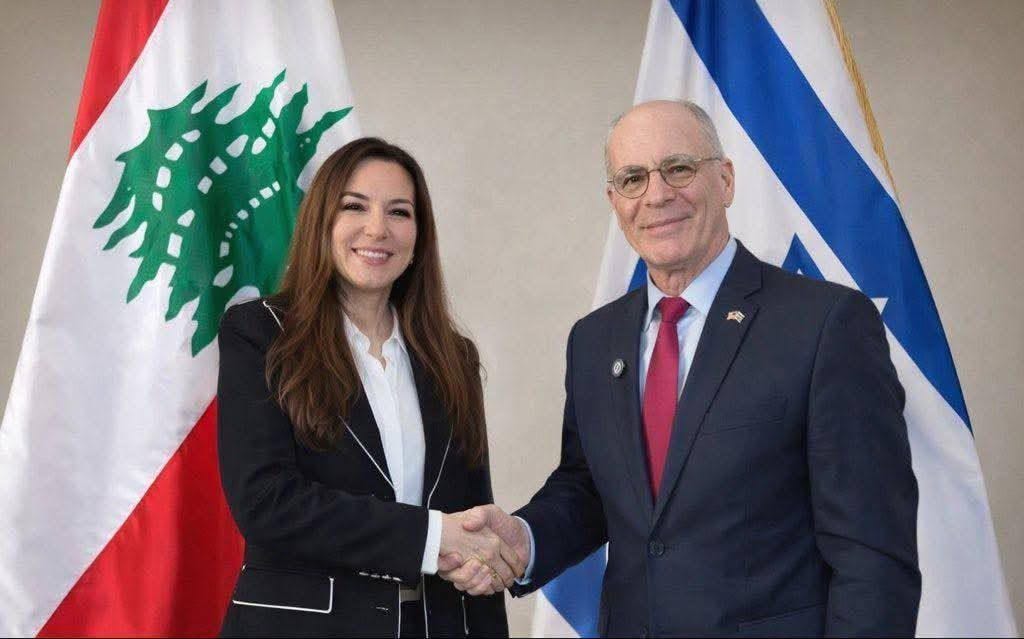
The image of the Lebanese ambassador shaking hands with the zionist entity representative in the United States was shocking.
Many felt that this was the end — that Lebanon had slipped into a point of no return.
But this moment, despite its symbolism, does not reflect the reality of the situation.
Symbols Do Not Create Political Reality
Political symbols do not always reflect reality — they are often used to manufacture it.
The handshake, despite its emotional impact, does not signal a strategic change in Lebanon’s position. It is an attempt to create the illusion that “the conflict is over.”
But political reality is not made in photographs.
It is made in the south — not in Washington.
The Ethical Contradiction
You cannot shake the hand of an enemy while his other hand is still on the trigger, firing at your own people.
A handshake does not erase a bullet, nor does it transform an aggressor into a partner.
As long as violence continues, any image presented as “peace” is nothing more than an attempt to beautify an ongoing reality.
Lebanon, despite its weaknesses, is not a state without weight. Every internal actor is tied to an external axis — and this interconnectedness places Lebanon inside global power balances, not on their margins.
♟️ Lebanon as a Chessboard… But Not in the Way Many Think
The conflict in Lebanon is not only internal; it is the intersection of international projects.
Some powers support Lebanese factions for strategic reasons, while others intervene for influence or interests.
But there are also states — such as Iran — whose involvement is not pushed by economic domination, but by supporting groups they view as targeted or oppressed.
This support is not “greed,” but a mutual protection pact:
It shields the weaker party from being crushed.
and shields the supporter from isolation
In this sense, Lebanon is not only exploited — it is protected in ways other states are not.
🛑 Why This Phase Is Different
For the first time in decades, Lebanon cannot be described as weak in the face of absolute power.
The zionist entity itself is in a position of vulnerability due to what happened in Gaza and the actions of regional actors.
The equation has changed dramatically:
settlers are living in fear and displacement
The image of “absolute superiority” has eroded.
Global awareness has shifted.
Old narratives no longer convince anyone.
Indicators That Cannot Be Ignored
Since October 7, the occupation
has witnessed the largest internal displacement in its history, with tens of thousands leaving northern and southern settlements.
This is not a detail — it is a sign of a shifting deterrence balance.
Meanwhile, global speech has changed:
“war crimes”
“possible genocide”
“collective punishment”
These terms now appear in UN reports, human rights organizations, and major newspapers like The Guardian and The New York Times.
Today’s moment is not about normalization—it is about a fundamental reconfiguration of power.
📜 History Is Clear: Every Attempt at Imposed “Settlement” Has Failed
Lebanon’s history with negotiations and agreements shows that every proposal was an attempt to impose a new reality — not a genuine settlement.
The 1949 armistice was fragile and changed nothing.
The 1983 May 17 Agreement fell apart within months because it did not reflect the will of the Lebanese people.
The 2020–2022 maritime border deal was technical, not political.
Why They Always Fail
The May 17 Agreement collapsed not only because of public rejection in Lebanon, but also because the balance of power on the ground shifted after the zionist entity withdrew from the mountains.
Any settlement that does not align with military and social realities is doomed to fail — no matter how strongly it is backed internationally.
🌍 The Battle Continues… But With a New Global Awareness
Even as Lebanon faces destruction and death, global awareness has changed.
Narratives once presented as unquestionable truths are now read as political myths — including the myth of a “chosen people” whose violence is beyond accountability.
Lebanon today is not only stronger militarily, but symbolically and politically.
The narrative has changed.
The other side is no longer the sole aggressor; it is now on the defensive.
And global public opinion has shifted, reshaping the confrontation.
The Project of “Greater Israel” Has Not Disappeared
The idea of “Greater israel” is still alive in political discourse inside occupied Palestine — through settlement expansion and rhetoric advocating full territorial control.
This alone exposes the contradiction in presenting today’s moment as “peace.”
A project built on expansion cannot, at the same time, be a project of existence.
🔵 Conclusion
They tried to make this moment look like the end — as if Lebanon had reached a point of no return.
But what this story forgets is memory.
We remember — as Palestinians and Lebanese — all the previous moments when we were told “this is the end,” that the Zionist project had succeeded, that the balance of power was permanently settled.
But every one of those moments collapsed.
From the 1949 armistice to the 1983 May 17 Agreement, to every attempt to impose settlements on Lebanon and Palestine — each was presented as a “final solution.”
And each one failed.
Today, they repeat the same script.
But we know — from experience, from history, from memory — that what is presented as an ending is merely a new chapter in a struggle that has never been resolved.
What is happening today is not the end of the ongoing aggression of the occupation.
It is the end of the illusion that you can control it.
And the transformation underway is not a conclusion — it is the beginning of a new phase in which the equation is rewritten, the limits of power are tested, and people reclaim their role in shaping their own destiny.
Taghrid Al-Mawed. Writing from Wales, but with my soul in Palestine.
Share widely — but please credit my writing